What invoice payment terms are
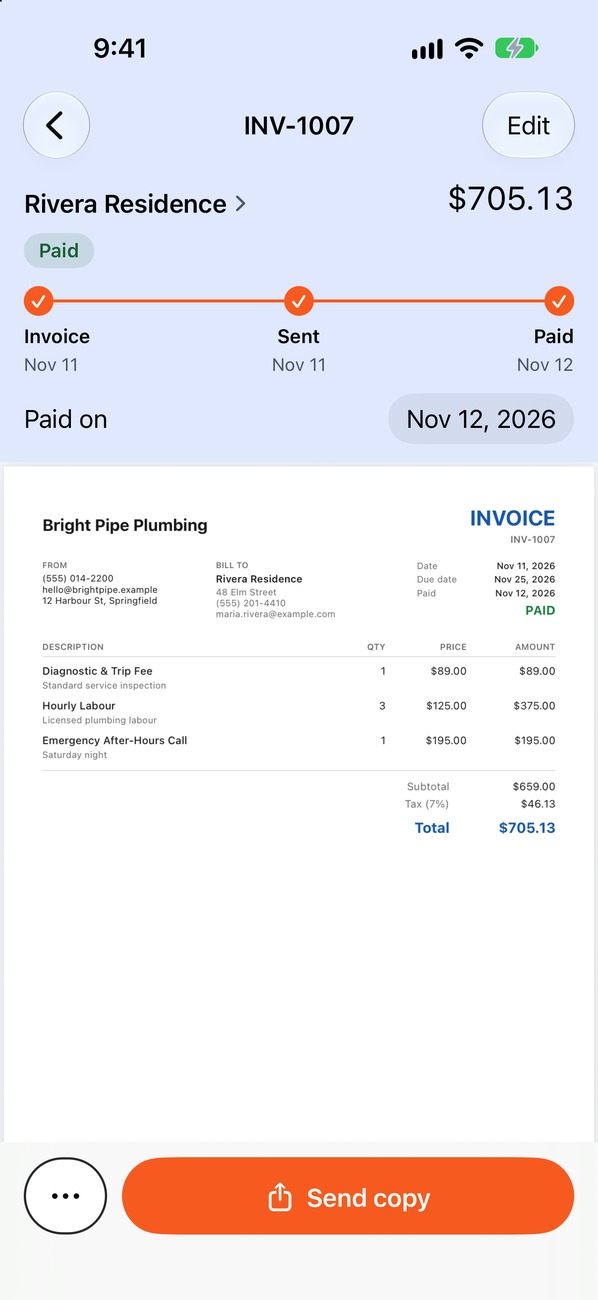
Payment terms are the conditions under which a customer pays you: when payment is due, which methods you accept and whether there is a deposit, discount or late fee. They belong on your estimate, so the customer agrees before work starts, and on every invoice so nobody has to look up what was agreed.
Common payment terms compared
| Term | What it means | Best for |
|---|---|---|
| Due on receipt | Payment is due as soon as the invoice is received | Small jobs, residential customers, one-off visits |
| Net 7 | Due 7 days after the invoice date | Quick turnaround on routine work |
| Net 15 | Due 15 days after the invoice date | Most small contractor and freelance work |
| Net 30 | Due 30 days after the invoice date | Business clients and larger projects |
| 50% upfront, 50% on completion | Half before work starts, the rest when done | Mid-sized jobs with material costs |
| Milestone payments | Fixed amounts at agreed stages | Longer projects. See the deposit schedule example |
How to choose the right term
- Think about your cash flow. If you buy materials upfront, shorter terms or a deposit protect you.
- Think about the customer. Homeowners often pay on completion, while companies with accounts payable teams may need Net 30 on their paperwork.
- Think about the job size. The bigger the invoice, the more it makes sense to split it into stages.
- Be consistent. Using the same terms for similar jobs makes your process simpler and easier to explain.
Wording you can copy
Clear wording avoids arguments. Adapt these lines to your business:
On the estimate: “A 25% deposit is due on approval. The remaining balance is due on completion of the work.”
On the invoice: “Payment due by November 24, 2026. Accepted methods: bank transfer, check or card. Please include invoice number 0042.”
Write the actual date rather than only “Net 15.” A calendar date leaves no room for different interpretations. Pago Invoice lets you print how to pay on every invoice, so the instructions travel with the document.
Late fees and early-payment discounts
A late fee only works if the customer agreed to it before the work, and many places limit what you can charge. Check local rules and state the exact fee and when it starts on the estimate and the invoice. Some businesses prefer a small early-payment discount instead, such as 2% off if paid within 10 days. Either way, apply it consistently, and keep your tone friendly when you remind customers. See our reminder templates.
Questions about payment terms
Does Net 30 start on the invoice date or the delivery date?
Usually the invoice date, unless you state otherwise. If your clients have different expectations, write the exact due date on the invoice.
Can I change payment terms for a repeat customer?
Yes. Agree the new terms in writing before the next job, and apply them from that point on.
What is the difference between “due on receipt” and “due on completion”?
“Due on completion” ties payment to the work finishing, usually on the same day. “Due on receipt” ties it to when the customer receives the invoice, so you should send the invoice promptly.
Are payment terms legally binding?
Terms agreed in writing form part of your agreement, but the rules on enforcing them vary by location. When in doubt, ask a local professional.