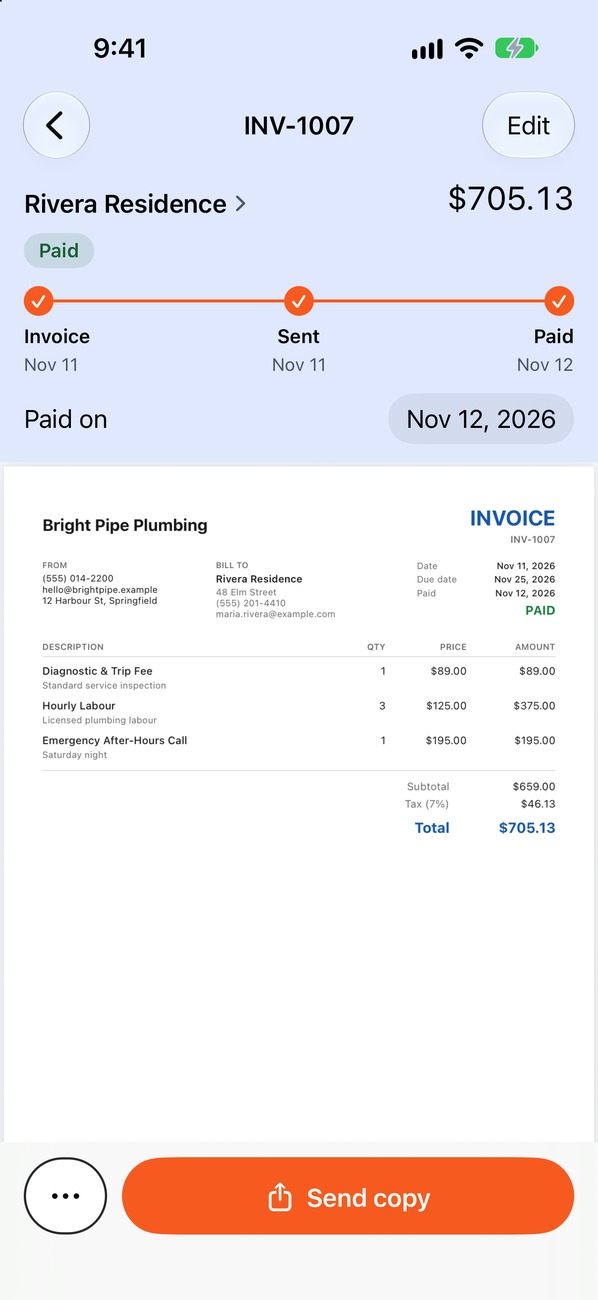
1. Identify the business, customer and job
Start with your business name and contact details, plus your license number if your trade or state requires it on paperwork. Then add the customer's name and the service address. For landlords and property managers, the billing address and the job address are often different, so show both.
Give the invoice its own number and an issue date so you and the customer can refer to the same document later. If the work happened on another day, show the service date too.
2. Describe the work line by line
Use a separate line for each service, part or material. A short description such as “replace kitchen faucet” or “clear bathroom drain” is far easier to review than a single “plumbing work” charge, and it answers most questions before the customer has to call you.
Separate labor from materials when it makes the job easier to follow. Show a service call or diagnostic fee as its own item. If the job ran after hours or on a weekend, say so on that line and make sure the rate matches the estimate or the terms you agreed.
3. Show tax, payments and the balance
List the tax that applies and show how it was worked out. Tax rules vary by location and by type of work, and some places tax parts and labor differently, so check your local rules rather than copying a rate from another job.
If the customer paid a deposit or part of the bill already, show the amount and the date it was received, and subtract it from the total. Finish with the amount still due, the due date and the payment methods you accept.
4. A worked example
Here is how a faucet replacement with a service call and a deposit might look once everything above is in place.
| Item | Qty | Rate | Amount |
|---|---|---|---|
| Service call and diagnosis | 1 | $89.00 | $89.00 |
| Labor: replace kitchen faucet | 1.5 h | $110.00 | $165.00 |
| Kitchen faucet, customer's choice | 1 | $185.00 | $185.00 |
| Supply lines and fittings | 1 | $24.50 | $24.50 |
| Subtotal | $463.50 | ||
| Tax (example rate, 8%) | $37.08 | ||
| Total | $500.58 | ||
| Deposit received Nov 3 | −$150.00 | ||
| Balance due by Nov 23 | $350.58 | ||
5. Common mistakes that slow down payment
- One vague line. “Plumbing work: $500” invites a phone call before it invites a payment.
- Forgetting the deposit. If money already received isn't shown, the customer has to work out the balance themselves, and may get it wrong.
- Surprises against the estimate. A higher total with no explanation is the most common reason an invoice gets disputed.
- No due date or payment details. Without them, “I'll pay when I get to it” becomes the default.
- The wrong address. Customers with several properties need to know which job the invoice is for.
Before you send it
- The customer's name and the job address are right.
- The work and materials match what was actually done.
- Quantities, rates and tax have been checked.
- Any deposit or partial payment is shown and subtracted.
- The balance due, due date and payment instructions are clear.
If the scope changed after the estimate, explain the added work on the invoice, and get the customer's agreement before treating it as a new charge.
Questions plumbers ask
Should labor and parts be on separate lines?
Usually, yes. It shows the customer what they paid for, makes it easier to apply different tax rules where they exist, and makes your own records clearer when you look back at a job.
What if the job cost more than the estimate?
Explain the difference on the invoice with its own line, such as “additional shutoff valve, found corroded.” Ideally, you agreed the change with the customer before doing the work.
How soon should I send the invoice?
As soon as the job is finished, while the work is fresh for both of you. Sending it from the job site, before you drive away, is the simplest way to avoid a backlog of paperwork.